Dyson Cordless Vacuum Technology: Inside the Engineering Revolution Behind 100 Million Digital Motors


Dyson cordless vacuum technology represents one of the most dramatic transformations in modern home appliances. What once seemed like a simple household cleaning tool has evolved into a masterpiece of industrial engineering—powered by digital motors spinning five times faster than a Formula 1 engine and assembled by hundreds of autonomous robots working with micron-level precision.
Behind every cordless vacuum lies a high-tech ecosystem of advanced materials, rare earth magnets, injection molding under extreme pressure, and relentless durability testing. To understand how something so ordinary became so technologically extraordinary, we must step inside the factories, laboratories, and research centers where innovation never stops.
This is the story of how Dyson redefined suction power, eliminated vacuum bags, and built a global manufacturing operation capable of producing over 100 million digital motors—forever changing what consumers expect from home technology.
The Birth of Dyson Cordless Vacuum Technology
The journey began in 1978, when engineer James Dyson noticed something remarkable at a local sawmill. Massive industrial cyclones were using centrifugal force to separate sawdust from the air—without relying on traditional filters.
At home, he was frustrated. His vacuum cleaner lost suction as soon as its dust bag clogged. Watching the cyclone system at the sawmill sparked a radical idea: what if cyclonic separation could be miniaturized for household use?
5,127 Prototypes and 14 Years of Persistence
The breakthrough didn’t happen overnight. Instead, it took 14 years of relentless experimentation. Working in an unheated garage, Dyson built 5,127 prototypes—many made from cardboard and masking tape. Each failure was documented and analyzed. Each iteration brought him closer to perfecting a vortex powerful enough to separate dust efficiently without a bag.
By 1993, the technology was ready for mass production in the United Kingdom. The result: the birth of bagless vacuum cleaning and the foundation of what would later evolve into advanced cordless systems powered by digital motors.
The Raw Materials Powering Dyson Cordless Vacuum Technology
Before assembly begins, a complex global supply chain gathers high-performance materials essential to Dyson cordless vacuum technology.
Polycarbonate: Strength Meets Transparency
The iconic clear dust bin is made from polycarbonate, a thermoplastic known for:
- Exceptional impact resistance
- High optical clarity
- Use in applications such as bulletproof glass
Its durability ensures long-term structural integrity while allowing users to see debris collection in real time.
ABS Plastic for Internal Precision
Engineers select Acrylonitrile Butadiene Styrene (ABS) for internal components. This material offers:
- Dimensional stability
- High surface finish
- Structural reliability under stress
Neodymium: The Rare Earth Engine Core
At the heart of Dyson cordless vacuum technology lies neodymium—a rare earth element used to create incredibly strong permanent magnets.
Approximately 80% of global neodymium production is sourced from China, where ore undergoes complex chemical treatment and leaching processes to isolate the pure element. These magnets enable the digital motors to reach astonishing rotational speeds of up to 125,000 revolutions per minute.
Advanced Supporting Materials
Other critical materials include:
- Ceramic motor shafts (three times stronger than steel)
- Carbon fiber filaments in cleaner heads (for anti-static dust pickup)
Every year, thousands of tons of these materials are transported through a vast logistics network to advanced manufacturing facilities in Southeast Asia.
Inside the High-Tech Manufacturing Facilities
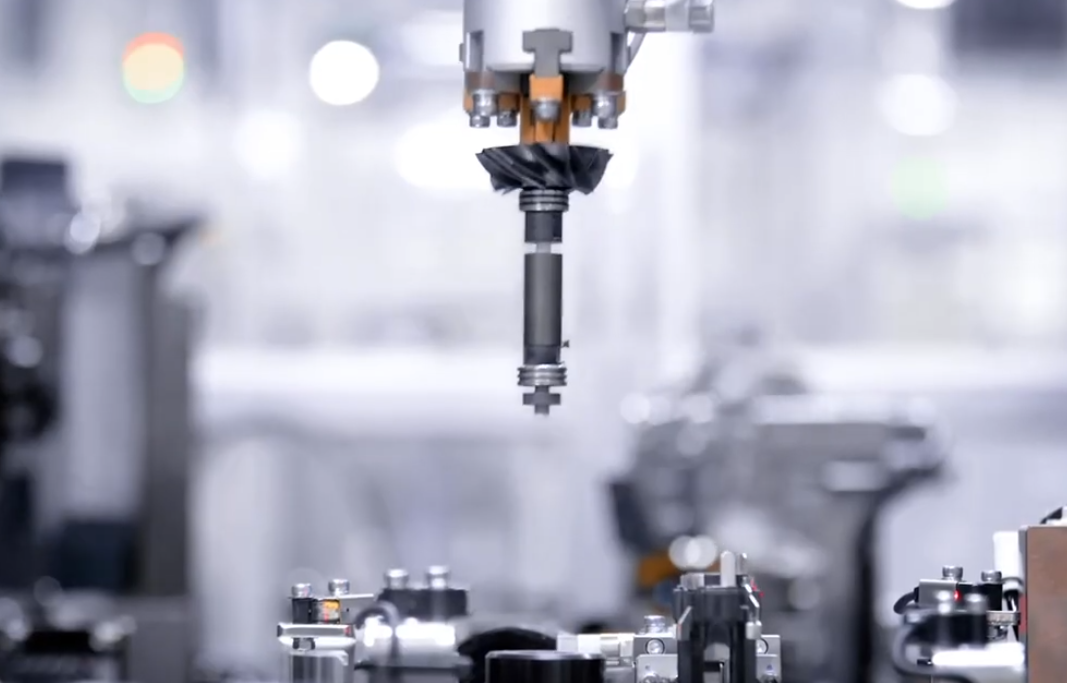
The production of Dyson cordless vacuum technology primarily takes place in Singapore and the Philippines—within facilities that resemble space-age laboratories.
The Singapore Advanced Manufacturing Center
In Singapore, the environment is meticulously controlled:
- Climate-regulated air
- Dust-free filtration systems
- Sealed robotic assembly units
More than 300 autonomous robots operate with micron-level accuracy. Six-axis robotic arms twist, rotate, and insert components hundreds of times per minute.
A fully functioning digital motor is completed every 2.6 seconds.
Human involvement is limited to supervision and feeding raw materials into the lines. Automation is critical because even microscopic misalignment at 125,000 RPM would result in catastrophic failure.
“Read Also: DJI Drone Manufacturing“
Advanced Injection Molding in Dyson Cordless Vacuum Technology
Creating the complex vacuum body requires extreme precision.
Moisture Elimination
Plastic pellets are dried at 120°C for four hours. Moisture above 0.02% could cause bubbles in the finished component.
High-Pressure Molding
Once dried, resin is heated between 280°C and 320°C and injected into multi-cavity molds under pressures up to 140 megapascals.
Overmolding for Airtight Seals
To ensure perfect cyclonic chamber sealing, engineers use overmolding—injecting rubber-like plastic onto existing parts to create integrated gaskets.
This process:
- Saves space
- Ensures airtight airflow paths
- Enhances structural integrity
Infrared sensors and virtual monitoring systems track temperature and pressure in real time, automatically rejecting defective components.
“Read Also: How Products Are Made“
Extreme Durability Testing: Engineering by Torture
Before reaching consumers, every product must survive a testing regime so demanding that engineers call it “torture.”
Mechanical Endurance
- Cleaner head neck joint swiveled 500,000 times
- Batteries charged and discharged over 6,000 cycles
- Machines run over 1,000 km across various floor types
Impact Testing
Prototypes undergo:
- Drop tests
- Crash simulations
- Wall impact tests
Acoustic Testing
In semi-anechoic chambers, machines are evaluated to ensure balanced sound quality and compliance with professional noise standards.
Filtration Efficiency
Scientists test real household dust in microbiology labs to confirm that filtration systems capture 99.97% of particles as small as 0.3 microns.
If a product fails during the 4,000th test, it returns to engineering for redesign. Only the most robust machines reach the market.
Beyond Vacuums: Expanding Dyson Cordless Vacuum Technology
The same high-speed digital motor technology used in cordless vacuums powers:
- High-speed hand dryers
- Professional hair stylers
By miniaturizing the motor to fit inside handles, engineers shift the center of gravity for improved ergonomics.
The same manufacturing principles are now being applied to robotics and wearable technology—where power density and intelligent airflow control represent the next frontier.
Packaging and Global Distribution
Automation continues through packaging.
Robot arms arrange components—metal extension tubes, vacuum heads, and main units—inside recycled cardboard inserts designed to prevent movement during transit.
From major shipping ports in Singapore and Johor, products are sent to more than 80 countries worldwide.
In key markets, orders placed before 5 p.m. can be dispatched the same day for next-day delivery—demonstrating the efficiency of a global logistics network moving millions of units annually.
Economic Impact and Global Market Leadership
Dyson currently holds approximately 25% of the global vacuum market share.
Key figures include:
- Over 100 million digital motors produced
- 13 million motors annually manufactured in the Philippines
- £8 million reinvested weekly into research and development
This investment fuels advancements in:
- Battery chemistry
- Artificial intelligence
- Software-based suction adaptation
Machines now adjust suction power automatically based on detected dust volume—transforming cleaning into an intelligent process.
From Garage Prototype to Global Manufacturing Excellence
The evolution of Dyson cordless vacuum technology—from cardboard prototypes to automated production lines producing a motor every two seconds—is a testament to iterative design.
Raw materials like polycarbonate and neodymium are transformed under extreme heat and pressure into sophisticated tools used daily in households worldwide.
Precision is measured in microns. Durability is proven through thousands of hours of testing. Failure is treated as feedback, not defeat.
This philosophy has redefined consumer expectations—turning cleaning into a scientifically optimized experience.
Frequently Asked Questions About Dyson Cordless Vacuum Technology
1. What makes Dyson cordless vacuum technology different?
It uses high-speed digital motors with cyclonic separation, eliminating vacuum bags while maintaining consistent suction power.
2. How fast do Dyson digital motors spin?
They can reach speeds of up to 125,000 revolutions per minute—five times faster than a Formula 1 engine.
3. Why is neodymium important in these vacuums?
Neodymium enables the creation of powerful magnets essential for high-speed motor performance.
4. How durable are Dyson cordless vacuums?
They undergo extreme endurance testing, including 500,000 swivel cycles and over 6,000 battery charge cycles.
5. Where are Dyson vacuums manufactured?
Production primarily takes place in Singapore and the Philippines within highly automated, climate-controlled facilities.
Dyson Cordless Vacuum Technology: Conclusion
Dyson cordless vacuum technology is far more than a household convenience—it is a showcase of modern engineering at its finest. From rare earth magnets and robotic assembly lines to extreme durability testing and global logistics, every step reflects precision, innovation, and relentless improvement.
What began as frustration with a clogged vacuum bag evolved into a global manufacturing powerhouse producing over 100 million digital motors. The transformation from garage experimentation to robotic perfection demonstrates how persistence and engineering excellence can redefine an entire industry.
Now we’d love to hear from you. Has cordless technology completely replaced traditional plug-in vacuums in your home? Or do you still prefer the old-school approach? Share your thoughts and join the conversation.