How the Big Mac Is Made: Inside the Industrial System Behind a Fast Food Icon

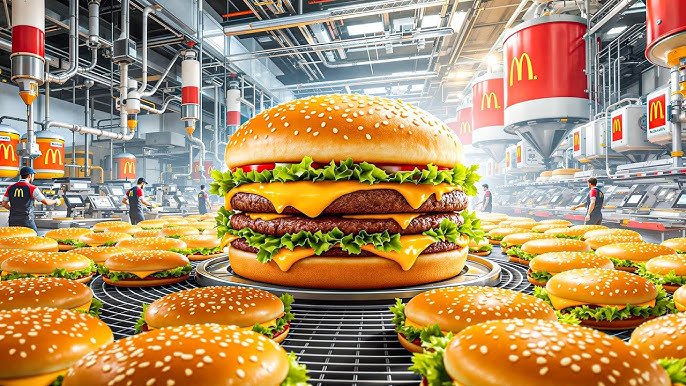
Every single day, factories connected to McDonald’s help produce the ingredients for more than 100,000 Big Macs—each one built to taste exactly the same no matter where in the world it is served. Behind this famous sandwich lies a hidden system of precision engineering, global agriculture, automation, and logistics that few customers ever see.
The Big Mac production process is not just fast food preparation—it is an industrial operation operating at massive scale. From cattle farms and wheat fields to high-speed patty formers, bun bakeries, vegetable processors, sauce plants, and distribution hubs, every element must arrive at the restaurant in perfect condition and perfect timing.
So how does McDonald’s ensure that every Big Mac tastes identical in more than 100 countries? Let’s step behind the scenes and uncover the system that turns simple ingredients into one of the most recognizable foods on Earth.
The Big Mac: More Than a Sandwich
Every 20 seconds, someone in the United States bites into a Big Mac. Globally, more than 500 million Big Macs are served every year. This consistency is no accident—it is the result of decades of industrial optimization.
A Big Mac is built from:
- A three-part sesame seed bun
- Two beef patties
- Shredded iceberg lettuce
- Pickles
- Onions
- American-style cheese
- The famous Big Mac sauce
Each ingredient has its own specialized supply chain, often involving different countries, factories, and technologies. The real challenge is synchronizing all of them.
Beef Patties: The Core of the Big Mac Production Process
Nothing matters more than the beef.
Global Beef Sourcing at Massive Scale
Big Mac patties begin as beef trimmings sourced primarily from cattle raised in:
- The United States
- Canada
- Australia
- New Zealand
McDonald’s sourcing strategy is designed for scale, safety, and uniformity. To meet global demand, suppliers process thousands of tons of beef every week.
Some facilities handle up to 3 million pounds of beef per day, breaking down entire carcasses into various cuts, including lean trimmings destined specifically for hamburger patties.
Grinding and Temperature Control
Inside the processing plant:
- Chilled beef arrives at receiving docks
- Meat is inspected and sorted
- Beef enters industrial grinders capable of processing 30,000 pounds per hour
Temperature control is critical. At every stage, the beef must remain below 40°F (4°C) to ensure food safety and preserve texture.
Patty Forming and Flash Freezing
After grinding, beef flows into high-speed forming machines that stamp patties with:
- Exact weight
- Precise thickness
- Uniform diameter
These machines can produce up to 1,000 patties per minute. Each patty weighs just over one-tenth of a pound.
Immediately after forming, patties are flash frozen. This rapid freezing prevents large ice crystals from forming, protecting the meat’s structure and ensuring consistent cooking performance.
Once frozen, patties are packed into labeled cartons and stored in massive freezers before entering temperature-controlled distribution trucks.
“Read Also: How M&M’s Are Made: Inside the World of the Most Famous Chocolate Candy“
Sesame Seed Buns: High-Volume Baking Precision
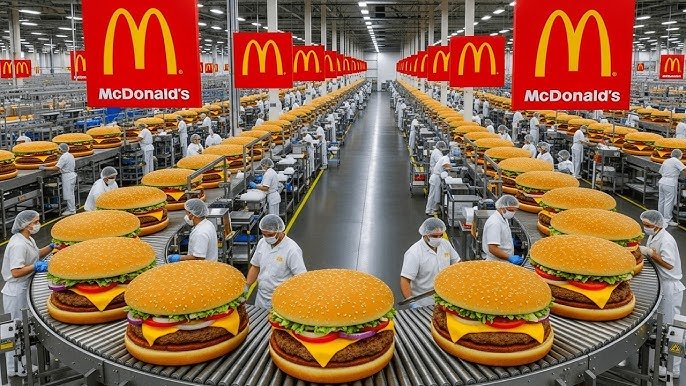
While the beef is processed in mega meat plants, Big Mac buns come from specialized industrial bakeries.
Wheat to Flour
Most wheat is grown in U.S. states such as:
- Kansas
- North Dakota
- Montana
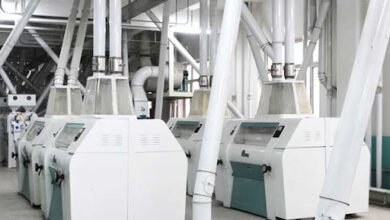
The grain is milled into high-protein flour, ideal for light yet sturdy buns.
Industrial Bun Baking
Dedicated bakeries can produce over 1 million buns per day.
The process includes:
- Mixing dough in vats holding over 1,000 pounds
- Resting the dough for gluten development
- Dividing and shaping
- Proofing in warm chambers
- Baking in tunnel ovens over 100 feet long
After baking, buns are lightly misted with water and coated with sesame seeds.
Uniformity is critical:
- Too tall → won’t fit packaging
- Too soft → collapses under fillings
After cooling, buns are sliced, packaged, and shipped—often traveling less than 500 miles from oven to restaurant.
Lettuce: Freshness at Industrial Speed
Big Mac lettuce uses iceberg lettuce, primarily sourced from California and Arizona.
Harvest and Rapid Cooling
Large-scale farms use mechanical harvesters to cut lettuce efficiently. Immediately after harvest, lettuce enters vacuum chillers, which reduce temperature from field heat to near freezing in under 30 minutes.
“Read Also: Lamb Processing Plant: The Incredible Journey from Farm to Perfect Lamb Shank“
Processing and Packaging
At vegetable processing plants:
- Lettuce is washed
- Precisely shredded
- Dried to remove excess moisture
- Vacuum sealed
Some facilities process up to 400,000 heads of lettuce per week, supplying millions of sandwiches.
Due to its short shelf life, lettuce logistics require precise timing and careful handling.
Pickles, Onions, and Cheese: Small Components, Big Systems
Pickles
Cucumbers are sourced from:
- India
- Turkey
- Southeastern United States
After harvest, cucumbers are:
- Brined in vinegar, salt, and spices
- Aged for several weeks
- Sliced using circular blade systems
Uniform thickness ensures consistent crunch and acidity.
Onions
Onions are:
- Diced
- Freeze-dried to preserve freshness
- Rehydrated in restaurants before use
This method extends shelf life while maintaining flavor.
Cheese
Big Mac cheese is an American-style processed slice produced in specialized plants combining:
- Milk
- Whey
- Emulsifiers
A single facility can produce over 2 million slices per day, designed to melt evenly without separating.
The Big Mac Sauce: A Guarded Industrial Formula
The Big Mac sauce is the sandwich’s signature element. While the exact recipe is confidential, it is known to include:
- Mayonnaise
- Mustard
- Sweet pickle relish
- Vinegar
- Spices
Sauce Manufacturing
The sauce is produced in large batching tanks holding hundreds of gallons. Emulsifiers ensure smooth texture and consistency.
The sauce is:
- Mixed
- Cold-filled into sealed containers
- Stored under refrigeration
Even minor variations are unacceptable, as flavor consistency is a cornerstone of the Big Mac experience.
Fries: An Industrial Process of Precision Engineering
No Big Mac meal is complete without fries.
Potato Sourcing
Potatoes are primarily russet varieties grown in:
- Idaho
- Washington
Truckloads arrive daily at fry processing plants.
Cleaning, Peeling, and Cutting
Potatoes pass through:
- Optical inspection systems
- Washing machines with rotating brushes
- Abrasive peeling drums
They are then sliced using water gun cutters, where high-pressure water propels potatoes through blades at extreme speed.
Cameras immediately inspect fry length and quality.
Blanching and Par-Frying
Fries are blanched in hot water for about three minutes to remove excess sugar and starch. This prevents uneven browning.
Next, fries are par-fried at around 375°F, locking in moisture and forming the initial golden crust.
After deoiling, fries are frozen and packaged for distribution.
Ketchup: Fully Automated Sauce Production
McDonald’s ketchup production is a model of industrial automation.
Cooking and Pasteurization
Tomato mixtures are cooked in:
- Steam kettles
- Vacuum cookers
Vacuum cooking preserves bright color and fresh flavor.
Filling and Packaging
Automated filling machines:
- Dispense precise volumes
- Fill bottles and sachets
- Inject nitrogen to preserve freshness
Containers are sealed, dated, labeled, cartoned, and palletized by robotic systems.
Central control systems monitor:
- Temperature
- Pressure
- Flow rate
- Volume
Any deviation triggers automatic correction or shutdown.
Distribution: A Just-in-Time Global Network
All Big Mac components move through a just-in-time inventory system, ensuring restaurants receive ingredients exactly when needed.
Temperature-controlled trucks, regional distribution centers, and strict tracking systems keep supply flowing smoothly.
If any link fails, the system feels it immediately.
Automation, Safety, and Quality Control
Throughout the Big Mac production process:
- Human contact is minimized
- Clean-in-place systems sanitize equipment
- Sensors monitor every variable
- Samples are tested continuously
The result is an unprecedented level of consistency across millions of daily servings.
Frequently Asked Questions About the Big Mac Production Process
1. Why does a Big Mac taste the same everywhere?
Standardized ingredients, strict specifications, and centralized quality control ensure uniform flavor worldwide.
2. Are Big Mac patties pre-cooked?
No. They are flash frozen raw and cooked fresh in restaurants.
3. How are buns kept uniform?
Industrial bakeries control size, height, softness, and moisture with extreme precision.
4. Why is lettuce shredded so finely?
Shredding ensures even distribution and consistent texture in every bite.
5. Is the Big Mac sauce made in restaurants?
No. It is manufactured in specialized sauce facilities and delivered ready to use.
Conclusion: The Industrial Genius Behind the Big Mac
The Big Mac production process is one of the most refined food manufacturing systems ever created.
From cattle farms and wheat fields to robotic fry lines and automated sauce fillers, every stage is engineered for speed, safety, and consistency. What appears to be a simple sandwich is, in reality, the product of global coordination, advanced automation, and relentless quality control.
This is how McDonald’s serves the same Big Mac—every time, everywhere.
Next time you unwrap one, remember: you’re holding not just fast food, but the result of one of the most sophisticated industrial food systems on the planet.