Industrial Marmalade Production: Inside the High-Tech Process Behind Every Jar

Have you ever wondered how industrial marmalade production transforms bitter oranges into the perfectly balanced sweet-and-tangy spread on your morning toast? While many assume marmalade is simply cooked fruit and sugar, the reality inside modern factories is far more complex, precise, and fascinating.
Behind every jar lies a sophisticated fusion of centuries-old culinary tradition and advanced food engineering.
Today, we’re taking you inside the world’s largest marmalade factories to uncover the remarkable process that produces millions of jars daily—without sacrificing flavor, texture, or safety. From carefully cultivated citrus groves to cutting-edge filling and sealing systems, industrial marmalade production represents one of the most technically refined processes in the global food industry.
The Origins of Marmalade and Its Evolution into Industrial Marmalade Production
Marmalade has deep historical roots, traditionally associated with Scottish kitchens where bitter oranges were slowly simmered with sugar to create a thick preserve rich in peel. Over centuries, this artisanal craft evolved.
What makes modern industrial marmalade production so impressive is that it preserves the essence of those traditional methods while scaling them to meet global demand. The fundamental principles—balanced sweetness, controlled bitterness, perfect gel consistency—remain unchanged. What has evolved is the precision, efficiency, and scale.
Despite being produced by the ton, industrial marmalade still aims to taste homemade. This delicate balance between heritage and technology defines the industry today.
Specialized Citrus Cultivation: The Foundation of Quality
The journey of marmalade begins long before fruit enters the factory.
Carefully Selected Orange Varieties
Not all oranges are suitable for marmalade. Factories rely on:
- Seville oranges
- Bitter oranges
- Specially bred high-pectin citrus varieties
These oranges are cultivated specifically for marmalade production. Unlike eating oranges, they are valued for:
- High natural pectin levels
- Distinct tartness
- Aromatic peel oils
Precision Harvest Timing
The timing of harvest is critical. Pectin levels peak at specific stages of ripeness. If harvested too early or too late, the fruit may not gel properly during cooking. In large-scale industrial marmalade production, even slight variations can disrupt entire batches.
Rigorous Quality Control Before Processing
Once harvested, oranges undergo extensive testing that surprises most consumers.
Each batch is analyzed for:
- Sugar content
- Acidity levels
- Pectin concentration
- Moisture content
Fruits are sorted not only by size but also by internal chemistry. When producing thousands of jars simultaneously, consistency is everything. Small differences in fruit composition can affect gel strength, flavor balance, and shelf stability.
This scientific precision is one reason industrial marmalade production achieves uniform results across millions of jars.
Advanced Washing and Optical Sorting Systems
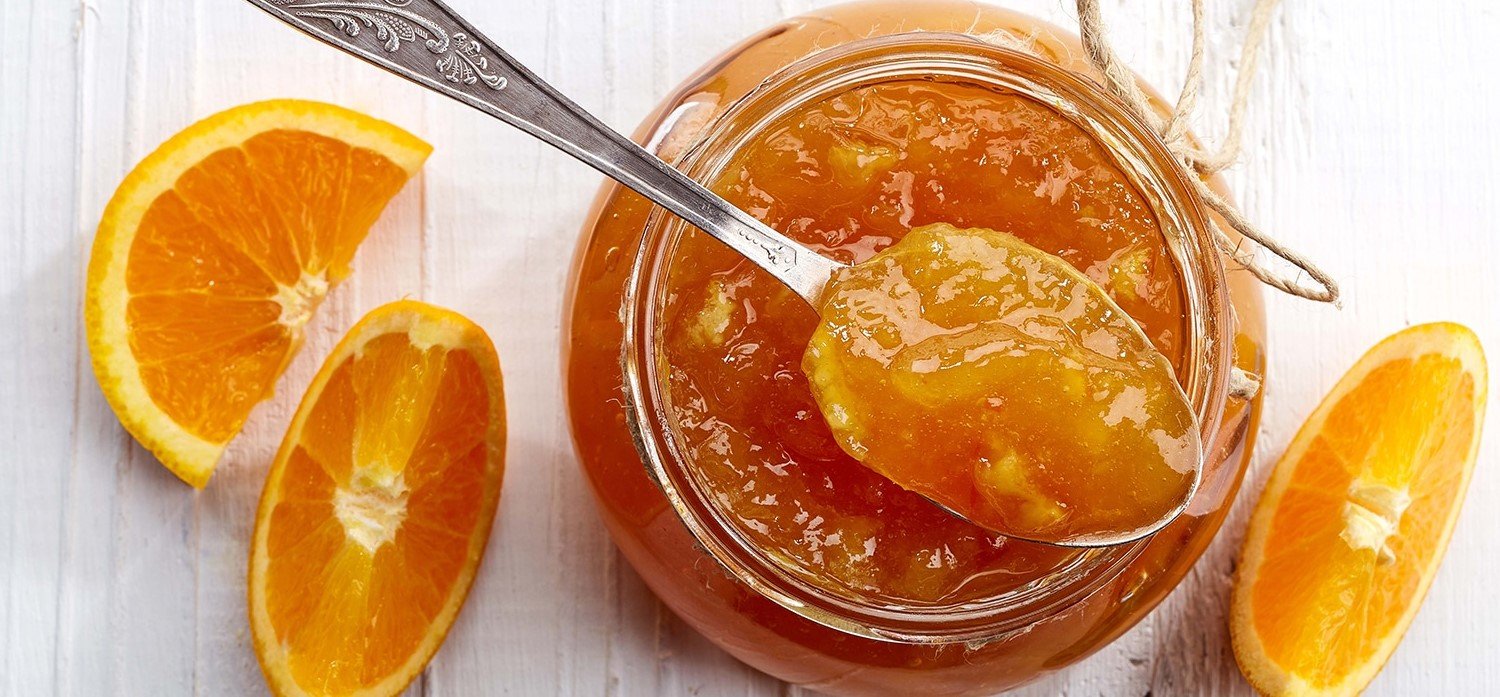
Before processing, oranges are thoroughly cleaned using advanced engineering systems.
Multi-Stage Washing Process
Industrial washing systems use:
- High-pressure water jets
- Rotating brushes
- Food-grade sanitizing solutions
These remove dirt, pesticide residues, and natural wax coatings.
Optical Sorting Technology
After washing, oranges pass through optical sorting machines equipped with cameras and sensors. These systems detect:
- Surface blemishes
- Shape irregularities
- Hidden defects
Automation ensures no flawed fruit enters production, enhancing food safety and maintaining high standards.
Peel Preparation: Defining Marmalade’s Character
Peel is what distinguishes marmalade from other fruit preserves. In industrial marmalade production, peel preparation is a highly controlled process.
Precision Peeling
Specialized machines process hundreds of oranges per minute. They are calibrated to:
- Remove only the outer zest
- Control how much white pith remains
- Adjust peel thickness depending on product style
Different peel treatments produce different flavor profiles—from mild to robustly bitter.
Uniform Peel Cutting
Industrial slicing machines create peel strips with millimeter precision. Factories can produce:
- Thick-cut traditional marmalade
- Fine-cut varieties
- Custom peel styles
Uniformity ensures even cooking and consistent texture in every jar.
Interestingly, machine cutting often surpasses hand cutting in consistency, ensuring identical distribution throughout the batch.
Juice Extraction and Pectin Recovery
While peel is prepared separately, the fruit flesh follows another path.
Industrial juice extractors:
- Squeeze maximum juice yield
- Separate seeds and pulp
- Preserve flavor compounds
Why Seeds Matter
Orange seeds contain high concentrations of natural pectin—the key gelling agent in marmalade. Rather than discarding them, factories process seeds separately to extract pectin for later use.
This integrated approach enhances efficiency and preserves natural ingredients.
The Science of Cooking in Industrial Marmalade Production
Cooking is where chemistry and tradition merge.
Steam-Jacketed Kettles
Massive kettles—sometimes holding several tons—provide:
- Precise temperature control
- Even heat distribution
- Efficient energy transfer
Unlike home kitchens, factories maintain exact thermal consistency.
Controlled Sugar Addition
Industrial producers don’t add sugar all at once. Instead, sugar is introduced in carefully timed stages. Depending on the recipe, factories may use:
- Regular sugar
- Invert sugar
- Glucose syrup
Each type is added at specific temperatures to optimize flavor development and preservation.
The Chemistry of Pectin and Gel Formation
As temperatures rise, natural pectin activates and begins forming a gel network.
Sensors continuously monitor:
- Temperature
- pH levels
- Viscosity
If necessary, additional pectin extracted from seeds is added at precisely the right moment.
Real-Time Gel Testing
Automated sampling systems remove small portions during cooking. Rapid gel tests predict how the final marmalade will set. Adjustments can be made instantly.
This level of monitoring ensures that every jar has identical consistency.
The Critical Role of Acidity
Acidity is essential in industrial marmalade production.
Producers balance:
- Natural citrus acidity
- Added citric acid
The correct pH ensures:
- Proper gel formation
- Flavor balance
- Preservation safety
Too little acid results in poor setting. Too much creates harsh flavor. Precision is everything.
High-Speed Filling and Sterilization
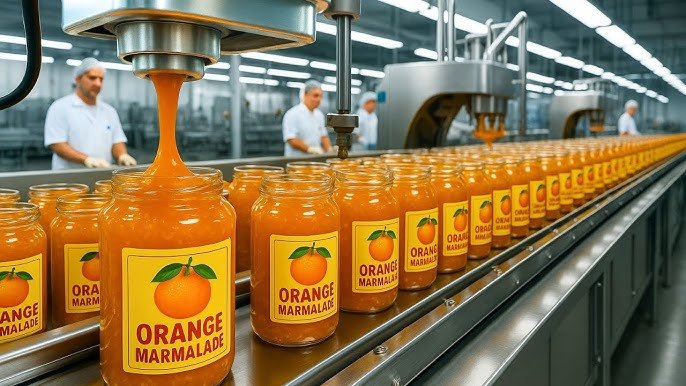
Once cooking is complete, marmalade moves quickly to the filling stage.
Jar Sterilization
Glass jars pass through:
- Steam tunnels
- Hot water baths
This eliminates microorganisms and preheats jars to prevent thermal shock.
Automated Filling
Industrial machines can fill hundreds of jars per minute while maintaining:
- Exact fill levels
- Optimal temperature
- Hygienic conditions
Hot filling helps create a vacuum seal, ensuring long shelf life.
Precision Sealing and Controlled Cooling
Capping machines apply lids with carefully calibrated torque.
- Too loose → contamination risk
- Too tight → glass breakage
After sealing, jars move through cooling tunnels where air circulation is precisely controlled. Cooling must be gradual enough to prevent texture issues but fast enough to ensure food safety.
“Read Also: Popeyes Chicken Production Process“
Post-Production Quality Assurance
Quality control continues long after sealing.
Random samples undergo:
- pH testing
- Texture evaluation
- Flavor profiling
- Microbiological analysis
Some factories even age samples for weeks to confirm stability and flavor maturation.
Traceability and Smart Packaging Systems
Modern packaging systems provide full traceability.
Each jar can be traced back to:
- Specific orange batches
- Cooking parameters
- Filling machines
- Production dates
This documentation enhances food safety and consumer trust.
Sustainability in Industrial Marmalade Production
Modern factories increasingly focus on environmental responsibility.
Citrus waste is often transformed into:
- Natural oils
- Animal feed
- Compost
- Bio-gas energy
Some facilities even generate energy from sugar residues in waste streams.
This integration of sustainability with food manufacturing demonstrates how tradition and environmental consciousness can coexist.
“Read Also: Mass-Produced Cinnamon Rolls“
Preserving Tradition at Scale
Perhaps the most remarkable aspect of industrial marmalade production is its ability to preserve the soul of traditional marmalade making.
Despite advanced sensors, automated systems, and high-speed machinery, the essential components remain unchanged:
- Bitter oranges
- Sugar
- Heat
- Time
- Balance
Technology enhances consistency and safety—but the heart of marmalade still lies in its centuries-old origins.
“Read Also: American Beef Brisket“
Frequently Asked Questions About Industrial Marmalade Production
1. What makes industrial marmalade different from homemade marmalade?
Industrial marmalade uses precise temperature control, automated testing, and standardized ingredients to ensure consistent quality across large volumes.
2. Why are Seville oranges commonly used?
Seville oranges contain high levels of natural pectin and acidity, which are ideal for gel formation and balanced flavor.
3. How do factories ensure proper gel consistency?
Factories monitor pH, temperature, and viscosity in real time and conduct rapid gel tests during cooking to guarantee accurate setting.
4. Is industrial marmalade less natural than homemade versions?
No. The primary ingredients remain fruit, sugar, and acid. Industrial methods improve safety and consistency without altering the fundamental recipe.
5. How long does industrial marmalade last?
Properly sealed jars have extended shelf life due to controlled acidity, sterilization, and airtight vacuum sealing.
Conclusion: The Remarkable World of Industrial Marmalade Production
The next time you spread marmalade on your toast, remember that behind that simple pleasure lies one of the food industry’s most sophisticated processes. Industrial marmalade production combines agricultural precision, food chemistry, advanced engineering, and culinary tradition to create a product that tastes timeless yet is manufactured with cutting-edge technology.
From carefully cultivated bitter oranges to high-tech gel testing and automated filling systems, every step reflects centuries of knowledge refined by modern innovation. The humble jar in your kitchen represents not just fruit and sugar—but a remarkable fusion of art, science, and industrial mastery.
If you found this deep dive into marmalade production fascinating, share it with fellow food lovers or explore more behind-the-scenes insights into how everyday foods are made.